


Horror K-Drama Tropes and Recurring Themes, Explained

From cult compounds to social critique, we break down the recurring devices that make horror K-dramas instantly recognizable.
Watch enough Korean horror and you start noticing the furniture. The same church basement. The same apartment complex scheduled for demolition. The same woman in white funeral clothes with her hair over her face, standing at the end of a corridor and declining to explain herself.
That repetition isn't laziness. Genre tropes are shorthand, and shorthand only works when writer and audience share a reference set.
The problem for the rest of us is that the reference set is Korean — built out of specific news cycles, specific funeral customs, and a specific housing market — so a lot of the meaning arrives with the subtitles stripped off.
This is the decoder ring. Four recurring themes that show up across almost everything in the genre, what they're actually pointing at, and why they land on viewers who have never set foot in Seoul. If you want titles rather than theory, 10 Horror K-Dramas That Will Haunt You Long After Watching is the place to start.
The Cult/Religious Institution Trope
If you've watched three Korean horror shows, you've met a religious organization with a charismatic leader, an unnervingly clean prayer hall, and a membership that looks like your aunt.
Take Save Me (2017): a family relocates from Seoul to a small rural county after the father's business collapses. When their son dies, the grieving mother is taken in by a local church called Guseonwon, whose leader is addressed as Spiritual Father. Her daughter spends the rest of the series trying to get her family out. Or Hellbound (2021): supernatural entities begin announcing the exact hour of individual deaths, then arriving to carry them out on camera, and a religious movement called the New Truth Society builds an entire theology around the idea that the dead deserved it.
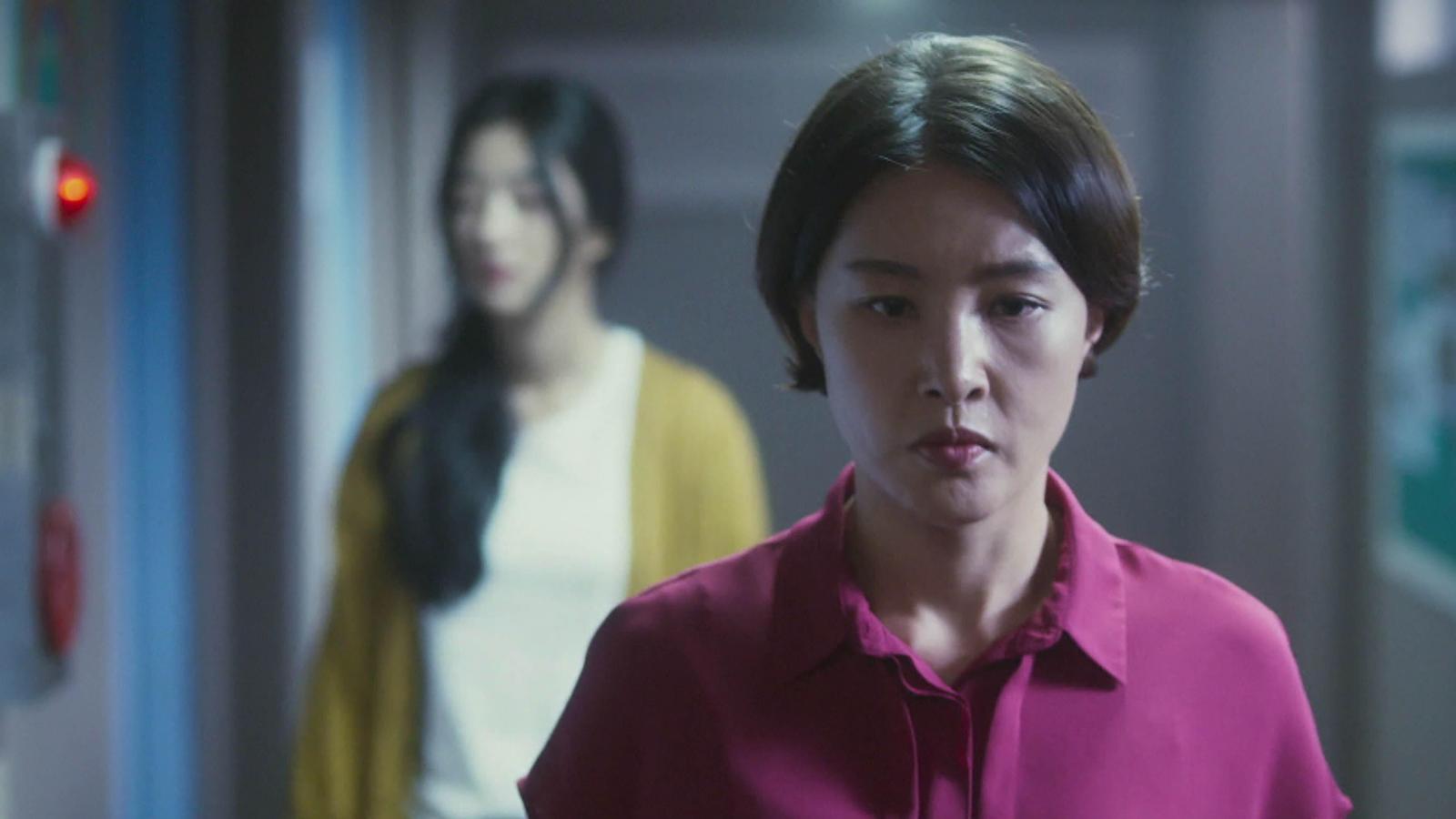
Here's the part that doesn't travel: in Korea, this isn't a fantasy scenario.
Korean audiences aren't watching a cult story. They're watching a dramatization of the last thirty years of headlines.
The list is long and public. In 1987, thirty-two bodies were found in a factory in Yongin, members of a religious business group. The 2014 Sewol ferry disaster led investigators straight to a religious sect whose founder controlled the shipping company. In 2016, a sitting president was impeached in a scandal involving a confidante whose father ran his own religious movement. In February 2020, a single church congregation in Daegu turned into the country's first major COVID outbreak.
In 2023, a Netflix docuseries laid out decades of abuse allegations against several sect leaders and became the most-discussed thing on Korean television that spring.
So when a drama shows a church quietly absorbing a bereaved mother, it isn't reaching for something exotic. It's using a threat model the audience already carries. And the mechanics are consistent across the genre:
- The recruit is grieving, broke, or both. Nobody joins because they're stupid. They join because something broke and the institution showed up with soup.
- The institution is competent. Clean buildings, organized volunteers, real childcare. It provides the social infrastructure that failed.
- Leaving costs more than joining. Family members are inside. So is your money.
- Nobody outside intervenes. Police defer, neighbors shrug, the state is a phone number that rings out.
The horror isn't the robes. It's the arithmetic — a system that offers care with an exit fee, aimed at people the ordinary safety net already lost.
Class and Social Commentary as Horror Device
The second recurring theme is money, and Korean horror is unusually direct about it. Where American horror tends to isolate its characters in a cabin, Korean horror tends to trap them in real estate they can't afford to leave.
- Strangers from Hell (2019) is the cleanest example: a young man moves to Seoul for an entry-level job and can only afford a goshiwon — a rooming house of windowless cubicles with shared bathrooms, originally built for exam students. He can't leave, because leaving means losing the job.
- Sweet Home (2020) sets its monster outbreak in a decaying apartment block awaiting demolition, where residents are stuck because the units are worthless.
- Happiness (2021) locks down a new high-rise during an outbreak and immediately splits the building along ownership lines: the residents who bought their units decide the ones on subsidized leases are the problem.
- Bargain (2023) opens on an illegal organ auction in a motel room and then drops the building in an earthquake, leaving buyers and merchandise stuck in the same rubble.
The specifics behind these settings are worth knowing:
- Goshiwon and banjiha. Cubicle rentals and semi-basement flats are ordinary housing for a lot of young workers, not set dressing. Anyone who saw Parasite has already seen a banjiha flood.
- Jeonse. The Korean lease system requires an enormous refundable deposit instead of monthly rent. A wave of fraud cases in 2022–23 wiped out tenants' life savings. Losing your deposit means losing everything at once.
- Redevelopment. Demolition notices, holdout tenants, and construction firms are a standing feature of Korean urban life, and a reliable horror setting.
The genre's most consistent argument: the monster is expensive to escape, and so is the apartment.
This is where the supernatural and the psychological branches of the genre converge. Strip the ghost out of most of these shows and the plot still functions as a story about debt. That's also why the psychological end of the spectrum tends to be the meanest — the ones covered in Best Psychological Horror K-Dramas Ranked mostly dispense with the supernatural and let the economic pressure do the work directly.
Folklore and the Supernatural as Cultural Anchor
Then there's the woman in white. She has a name, a costume with a reason, and a set of rules.
Korean ghosts are called gwishin, and the standard visual — white robes, long loose black hair, bare feet — is funeral dress. The clothing signals a death that was never properly closed out. That matters because Korean ritual practice puts enormous weight on getting the dead processed correctly: ancestral rites performed on schedule, the body buried in the right place, Buddhist observance across the forty-nine days after death. A ghost is, functionally, an administrative failure.
The related concept is han — usually translated as accumulated grievance or unresolved resentment.
It's the engine of most Korean hauntings: the ghost isn't evil, it's owed. Resolve the debt and it leaves.
Worth noting that han is contested territory; a number of scholars argue the idea was consolidated during the Japanese colonial period and then hardened into national self-description, so treat it as a useful narrative logic rather than an eternal cultural essence.
The other recurring figure is the mudang, a shaman — usually a woman — who negotiates with spirits through a ritual called a gut. Shamanic practice sits alongside a religious landscape that is roughly a fifth Protestant, under a tenth Catholic, and majority unaffiliated. The pattern in the dramas mirrors this: a family calls a priest, gets nowhere, and ends up calling a shaman.
You can see the whole apparatus operating in:
- Revenant (2023) — a broke young woman inherits her estranged father's belongings, and an entity attached to one of them starts granting wishes and collecting payment in bodies. The investigation is folkloric: identify the object, identify the grievance, settle it.
- The Guest (2018) — a man from a shamanic family line, a Catholic priest, and a detective chase a single demon across decades, with the ritual toolkit switching between traditions depending on what's failing.
- The Bequeathed (2024) — a woman inherits a family burial ground she didn't know existed, which drags in Korean geomancy, the taboos around relocating graves, and a set of relatives with claims.
Western horror asks whether you believe in ghosts. Korean horror generally skips ahead and asks what the ghost wants, which is a more interesting question and usually has a paper trail.
The full folklore inventory — nine-tailed foxes, water ghosts, the black-suited reapers who escort the dead — gets unpacked in Supernatural Horror K-Dramas: Curses, Ghosts, and Korean Folklore.
Why These Tropes Resonate Beyond Korea
Here's the thing about the cultural context horror fans outside Korea often assume they're missing: you don't need it to be frightened. You need it to know what you were frightened of.
Three reasons this stuff exports so well.
The anxieties are portable. Unaffordable housing, precarious work, institutions that collect from you and disappear when you need them. A viewer in Amsterdam or Chicago doesn't need a briefing to understand a young man who can't quit a job or leave a building.
The format allows sociology. This is where K-drama horror conventions differ hardest from film. Twelve to sixteen hours means a show can spend three episodes on a neighborhood before anything supernatural occurs, so by the time the horror starts you know the mortgage situation of everyone involved. Streaming-native runs of six to eight episodes have tightened this, but the instinct survives. The comparison between the two formats — and why the films are nastier while the series are sadder — is worked through in Korean Horror Movies vs K-Dramas: A Beginner's Guide.
The moral structure is legible. Most Korean hauntings operate on grievance rather than arbitrary malice. Someone did something. The dead want it acknowledged. That gives even the bleakest entries a spine of justice that a lot of Western horror declines to supply.
A short field guide for spotting the machinery in whatever you watch next:
- A rural village signals collective complicity — everyone knows, nobody says.
- An apartment complex signals class sorting under pressure.
- A school signals bullying and the exam system, and the ghost is usually a former student.
- A religious institution signals a failure of the social safety net.
- A shaman signals that the official channels have already been tried and didn't work.
None of this ruins the scares. If anything the opposite: once you can read the conventions, the good shows stop being scary in a generic way and start being scary in a specific, argued, extremely deliberate way. Which is worse. Enjoy.